Source: USDA FoodData Central · Raw · Data verified by CaloriesCalc
43
kcal
per 100g, raw
9.61
g
Carbs
1.39
g
Protein
0.49
g
Fat
5.3
g
Fiber
1
kcal per berry (3.5g)
62
kcal per cup (144g)
12
kcal per oz (28g)
✔ Ultra low calorie✔ High in fiber✔ Rich in anthocyanins✔ Keto-friendly✔ Gluten free✔ Vegan
🫐
⬛Richest in anthocyanins among berries
🌿High fiber — 5.3g per 100g
🛡Vitamin C — 21mg per 100g
✅Keto-friendly — 4.3g net carbs
🧠Supports brain health and memory
❤️Anti-inflammatory polyphenols
🫐 Calculate Calories for Any Blackberries Weight
Weight100g
Nutrition Facts
Per 100g (raw blackberries)
* % Daily Value based on a 2,000 kcal diet.
Quick summary: Blackberries contain 43 calories per 100g — one of the lowest of any berry. A cup provides 62 calories with 211mg of anthocyanins (highest among common berries), 5.3g of fiber, 40% of daily manganese, and 17% of vitamin K. With only 4.3g of net carbs per 100g, blackberries are keto-friendly and have a very low glycemic index of ~25.
Vitamins & Minerals — per 100g
Nutrient
Amount
% Daily Value
Bar
Manganese
0.93 mg
40%
Vitamin K
19.8 µg
17%
Vitamin C
21.0 mg
23%
Folate (B9)
25 µg
6%
Copper
0.17 mg
19%
Potassium
162 mg
3%
Magnesium
20 mg
5%
Vitamin E
1.17 mg
8%
Calcium
29 mg
2%
Phosphorus
22 mg
2%
Calories in Blackberries by Weight
Weight
Calories
Carbs
Protein
Fat
Calories in Different Blackberries Servings
Serving
Weight
Calories
Carbs
Net Carbs
Fat
1 blackberry
3.5g
2 kcal
0.3g
0.2g
0.0g
10 blackberries
35g
15 kcal
3.4g
1.5g
0.2g
½ cup
72g
31 kcal
6.9g
3.1g
0.4g
⭐ 1 cup (standard)
144g
62 kcal
13.8g
6.2g
0.7g
1 oz
28g
12 kcal
2.7g
1.2g
0.1g
How does blackberries fit your daily calorie goal?
Calculate your TDEE to see exactly how it fits your daily budget
Blackberries are 88% water with only 4.3g of net carbs per 100g. Their unusual macro profile includes relatively high protein for a fruit (1.39g/100g) and the highest fiber-to-calorie ratio of any common berry. At 43 kcal per 100g they are among the lowest-calorie berries available.
Micronutrient Highlights
🫐
Anthocyanins
~211 mg
Antioxidant
Highest among common berries — brain and heart protective
🌿
Fiber
5.3 g
19% Daily Value
Gut health, satiety, blood sugar control
🛡
Vitamin C
21.0 mg
23% Daily Value
Immune support and collagen
🔬
Manganese
0.93 mg
40% Daily Value
Highest manganese of any common berry
🦴
Vitamin K
19.8 µg
17% Daily Value
Bone health and blood clotting
⚡
Potassium
162 mg
3% Daily Value
Blood pressure and muscle function
Blackberry Health Benefits & Nutrition
Highest Anthocyanin Content Among Common Berries
Blackberries contain approximately 211mg of anthocyanins per 100g — more than blueberries (163mg), raspberries (40mg), or strawberries (36mg). These deep purple pigments are potent antioxidants that cross the blood-brain barrier and accumulate in regions critical for memory, learning, and coordination. Regular consumption of anthocyanin-rich foods is associated with a 24% reduced risk of cognitive decline in large population studies.
Highest Manganese of Any Common Berry
Blackberries provide 0.93mg of manganese per 100g — 40% of the daily value — making them the richest common berry source of this trace mineral. Manganese is essential for activating superoxide dismutase (SOD), the body's primary antioxidant enzyme. It also plays roles in bone formation, wound healing, and carbohydrate metabolism. A cup of blackberries provides more manganese than most nuts or seeds on a per-calorie basis.
Blood Sugar and Insulin Regulation
Blackberries have a low glycemic index of approximately 25, similar to raspberries. Their high fiber content (5.3g/100g) significantly slows sugar absorption. A 2020 study found that blackberry consumption before a meal reduced post-meal blood glucose by 18% and insulin by 24% in healthy adults, suggesting active compounds beyond fiber are modulating the glycaemic response — likely anthocyanins inhibiting alpha-glucosidase activity.
Vitamin K and Bone Health
Blackberries contain 19.8µg of vitamin K per 100g — 17% of the daily value, making them one of the better fruit sources of this fat-soluble vitamin. Vitamin K is essential for osteocalcin production — a protein that anchors calcium into bone matrix. Inadequate vitamin K is associated with increased fracture risk, osteoporosis, and calcium deposits in arteries. Regular blackberry consumption contributes meaningfully to the vitamin K intake needed for skeletal and cardiovascular health.
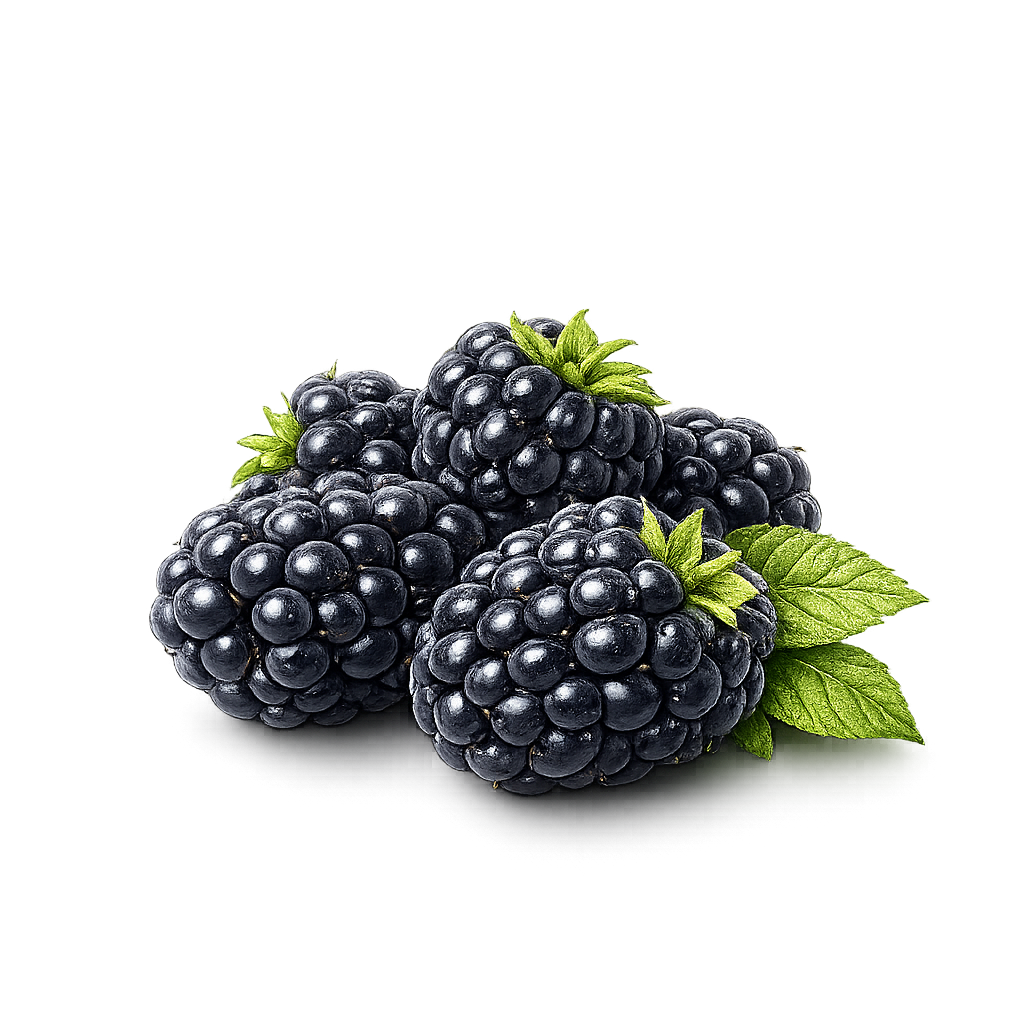
Blackberries contain 43 calories per 100g. A cup of blackberries (144g) has 62 calories. A single large blackberry (3.5g) has about 2 calories. Use the slider above to calculate for any weight.
Are blackberries keto?
Yes — blackberries are excellent for keto. With only 4.3g of net carbs per 100g, a cup (6.2g net carbs) fits easily into most ketogenic diets. They provide anthocyanins and fiber that are difficult to obtain otherwise on a very low-carb diet.
Are blackberries good for you?
Yes — blackberries are among the most nutritionally dense berries. They have the highest anthocyanin content of any common berry (211mg/100g), highest manganese (40% DV), significant vitamin K (17% DV), vitamin C (23% DV), and 5.3g of fiber per 100g — all for just 43 calories.
Are blackberries good for weight loss?
Yes. At 43 kcal per 100g with 88% water and 5.3g fiber, blackberries create exceptional satiety per calorie. A generous 200g bowl contains only 86 calories but provides significant fiber and volume, making blackberries one of the best foods for managing hunger on a calorie deficit.
Are blackberries and mulberries the same?
No. Blackberries (Rubus species) and mulberries (Morus species) are completely different plants. Blackberries grow on thorny bramble bushes while mulberries grow on trees. They look similar but mulberries are sweeter, higher in sugar (9.8g vs 4.9g per 100g), and have a different polyphenol profile. Nutritionally, blackberries are generally superior for antioxidant content.
Can I eat blackberry seeds?
Yes — the seeds are edible and beneficial. Blackberry seeds contain ellagitannins that are converted to ellagic acid and urolithins by gut bacteria. Urolithins are postbiotic compounds associated with improved mitochondrial function and muscle health in emerging research. The seeds also contribute to the fiber content.