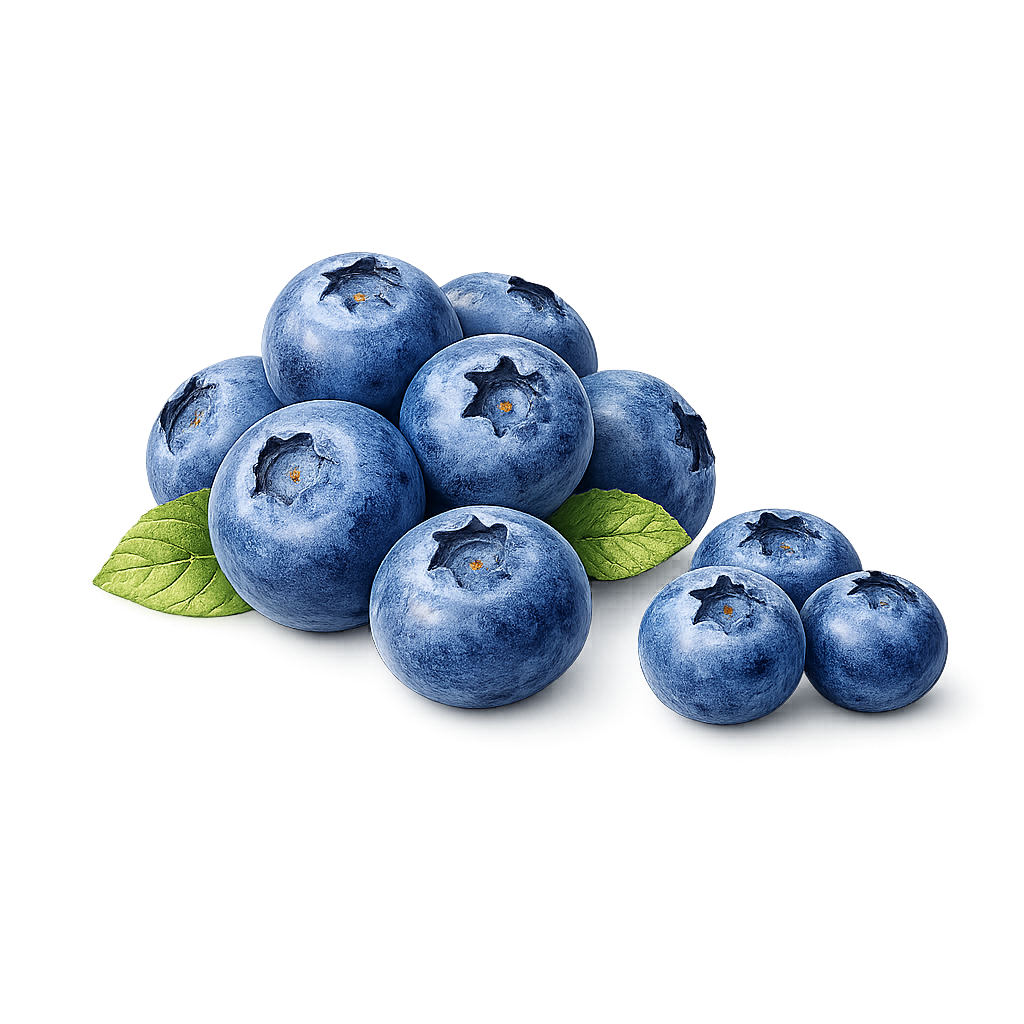
Source: USDA FoodData Central · Raw · Data verified by CaloriesCalc
57
kcal
per 100g, raw
14.5
g
Carbs
0.74
g
Protein
0.33
g
Fat
2.4
g
Fiber
1
kcal per berry (1.4g)
84
kcal per cup (148g)
16
kcal per oz (28g)
✔ Antioxidant powerhouse✔ High in vitamin C & K✔ Brain health✔ Fat free✔ Gluten free✔ Vegan
🫐
🫐#1 antioxidant fruit by ORAC score
🧠Boosts memory & brain health
❤️Reduces LDL cholesterol
🛡High in vitamin C & K
🩸may support blood sugar management
🥗Naturally fat free
🫐 Calculate Calories for Any Blueberry Weight
Weight100g
Nutrition Facts
Per 100g (raw blueberries)
* % Daily Value based on a 2,000 kcal diet.
Quick summary: Blueberries contain 57 calories per 100g and 84 calories per cup. They have the highest antioxidant capacity of any common fruit, driven by anthocyanins that give them their distinctive blue-purple colour. Regular consumption is linked to improved memory, reduced cardiovascular risk, better insulin sensitivity, and associated with cardiovascular health in research. With 84% water content and only 12.1g of net carbs per 100g, blueberries are one of the most nutritionally dense low-calorie foods available.
Vitamins & Minerals — per 100g
Nutrient
Amount
% Daily Value
Bar
Vitamin K
19.3 µg
16%
Vitamin C
9.7 mg
11%
Manganese
0.34 mg
15%
Vitamin B6
0.05 mg
3%
Folate (B9)
6 µg
2%
Potassium
77 mg
2%
Copper
0.06 mg
7%
Vitamin E
0.57 mg
4%
Magnesium
6 mg
1%
Calcium
6 mg
1%
Calories in Blueberries by Weight
Weight
Calories
Carbs
Protein
Fat
Calories in Different Blueberry Servings
Serving
Weight
Calories
Carbs
Net Carbs
Fiber
1 blueberry
1.4g
1 kcal
0.2g
0.2g
0.03g
10 blueberries
14g
8 kcal
2g
1.7g
0.3g
1 oz (~20 berries)
28g
16 kcal
4.1g
3.5g
0.7g
½ cup
74g
42 kcal
10.7g
8.9g
1.8g
⭐ 1 cup (standard)
148g
84 kcal
21.5g
17.9g
3.6g
1 pint (2 cups)
296g
169 kcal
43g
35.8g
7.1g
How do blueberries fit your daily calorie goal?
Calculate your TDEE to see how many cups fit your daily budget
Blueberries are 84% water. Their carbs come from natural fructose and glucose. Net carbs are 12.1g per 100g — moderate for a berry but higher than strawberries (5.7g).
Micronutrient Highlights
🫐
Anthocyanins
~163 mg
Antioxidant
Highest among common fruits — brain & heart protective
🦴
Vitamin K
19.3 µg
16% Daily Value
Bone health & blood clotting
🛡
Vitamin C
9.7 mg
11% Daily Value
Immune support & collagen
🔬
Manganese
0.34 mg
15% Daily Value
Activates antioxidant enzymes
🌿
Fiber
2.4 g
9% Daily Value
Gut health & blood sugar control
🍃
Pterostilbene
~0.1 mg
Antioxidant
Anti-inflammatory, may lower cholesterol
Blueberry Health Benefits & Nutrition
The World's #1 Antioxidant Fruit
Blueberries consistently rank first or second among commonly consumed fruits and vegetables for antioxidant capacity (ORAC score: ~4,669 per 100g). The primary compounds responsible are anthocyanins — the pigments that create the deep blue-purple colour. One cup of blueberries contains approximately 241mg of anthocyanins, significantly more than blackberries (211mg), raspberries (56mg), or strawberries (36mg).
Blueberries and Brain Health
Among all foods studied, blueberries have the strongest evidence for cognitive benefits. A landmark Harvard study following 16,000 women over 20 years found that those who ate the most blueberries delayed cognitive ageing by up to 2.5 years. The mechanism is anthocyanins crossing the blood-brain barrier and accumulating in regions critical for memory and learning. In a controlled trial, older adults who drank blueberry juice daily for 12 weeks showed significant improvements in memory and reduced depressive symptoms.
Cardiovascular Benefits
A 2019 randomised controlled trial in the journal European Journal of Nutrition found that eating one cup of blueberries daily for 6 months reduced cardiovascular risk by up to 15% in overweight adults. Specific effects included a 12% reduction in LDL cholesterol oxidation, improved blood vessel function (flow-mediated dilation), and associated with cardiovascular health in research. These effects are primarily attributed to anthocyanins interacting with nitric oxide production in blood vessels.
Blood Sugar and Insulin Sensitivity
Despite containing natural sugars, blueberries have a low glycemic index of approximately 53. Their polyphenols appear to inhibit alpha-glucosidase — the enzyme that breaks down carbohydrates — slowing sugar absorption. Regular consumption (2+ cups per week) is associated with a 23% lower risk of type 2 diabetes in large population studies.
Blueberries contain 57 calories per 100g. A standard cup (148g) has 84 calories. A single blueberry weighs about 1.4g and has approximately 1 calorie. Use the slider above to calculate for any weight.
Are blueberries a nutrient-dense food?
By most reasonable definitions, yes. Blueberries have the highest antioxidant capacity of any commonly eaten fruit, with strong clinical evidence for benefits to brain health, cardiovascular health, blood sugar regulation, and inflammation. They are nutritionally exceptional relative to their calorie content.
Are blueberries keto?
In small portions. Blueberries have 12.1g of net carbs per 100g, which is relatively high for keto. A ¼ cup (37g) contains about 4.5g net carbs and may fit into a flexible low-carb diet. Strict keto (under 20g/day) would limit you to very small portions.
Are frozen blueberries as healthy as fresh?
Yes — and in some ways better. Evidence suggests frozen blueberries retain most of their anthocyanin content. Some research found that freezing actually increases anthocyanin bioavailability by rupturing cell walls. Frozen blueberries without added sugar are nutritionally equivalent to fresh and available year-round.
How many blueberries should I eat per day?
Most research showing cognitive and cardiovascular benefits used doses of ½ to 1 cup (74–148g) per day. This provides 84 calories, 3.6g of fiber, and approximately 120–240mg of anthocyanins. Daily consumption appears more beneficial than occasional large servings.
Do blueberries help with memory?
The evidence is among the strongest of any food. Multiple randomised controlled trials and large observational Evidence suggests regular blueberry consumption improves memory and processing speed in older adults, and may delay age-related cognitive decline by 2–3 years with habitual consumption.